
If you run a business and have spent the last 18 months working out how AI fits into your operations, this week’s headlines will have given you a jolt. On Thursday 5 November the S&P 500 fell 4.4%, its worst day since the “Liberation Day” tariff shock of April 2025, and the Nasdaq dropped 5.5% into correction territory. Nvidia alone fell 9.3%. Search interest in “did the AI bubble just pop” reportedly rose 1,400% in a week.
So it’s a fair question to ask. If the bubble bursts, does the AI your business is building on go with it?
My short answer is no and I think the confusion comes from two very different things sharing one name. There’s AI the investment trade, which is a story about capital, valuations and who funds whom. And there’s AI the operational capability, which is a story about whether a model can read a lease, triage an inbox or reconcile a ledger more reliably than the process you have now. The first can collapse without the second going anywhere. History suggests it may even get better.
What the AI bubble actually is
When people talk about the AI bubble, they almost always mean the infrastructure build-out and the money circulating around it. Goldman Sachs puts AI capital spending by the five largest US hyperscalers (Amazon, Alphabet, Microsoft, Oracle and Meta) at about $800bn this year, rising to around $1.2tn in 2027. By its own estimate, roughly $300bn a year of AI revenue is needed to justify that.
The part that makes people uneasy is how the money moves. In simplified form it runs like this.
- Chip makers sell GPUs to the data centre operators and cloud providers.
- Those operators rent the compute to the AI labs and platforms.
- The labs raise money to pay for that compute, and some of it comes from the chip makers themselves.
- That investment flows back into buying more chips, which lifts the chip makers’ revenue and share price.
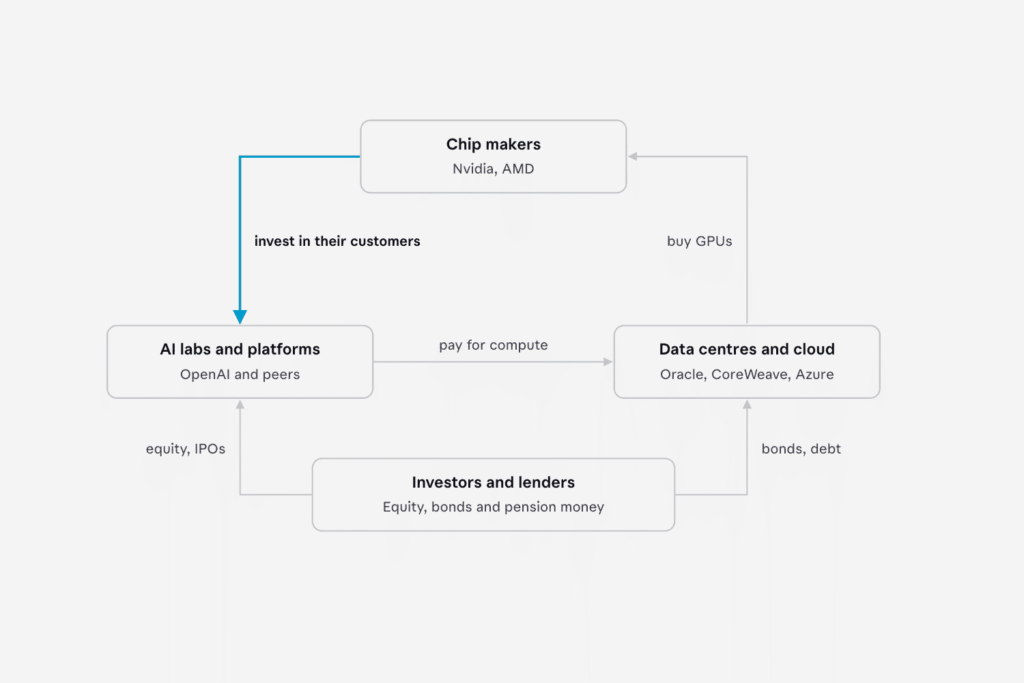
The highlighted link is the one critics focus on, where suppliers fund the customers who then buy from them.
The headline example is Nvidia’s September 2025 letter of intent to invest up to $100bn in OpenAI, which would in turn fill new data centres with Nvidia hardware. Jensen Huang later said that figure was “never a commitment”, but this August Nvidia agreed to put up to $105bn behind a huge Ohio campus to be leased by OpenAI. OpenAI has also signed a five-year, $300bn cloud deal with Oracle and a chip deal with AMD that could make it one of AMD’s largest shareholders.
The IMF’s October Global Financial Stability Report looked at 14 public AI deals since 2023. Together they involved about $300bn of equity and $650bn of supporting debt, with around $1.4tn of future revenue commitments flowing back to the investors. That’s the loop you’ve probably seen sketched on LinkedIn, and broadly it’s accurate.
Is the loop as circular as it looks?
Partly, and it’s worth being fair to both camps here.
The case for a bubble is strongest on funding. Some of the biggest spenders are now laying out more than they earn. Alphabet reported negative free cash flow of $9.1bn last quarter and Meta posted its first negative free cash flow in over a decade, then announced plans to raise up to $95bn in new equity. Nvidia, AMD and Broadcom expressed interest in buying up to $5bn of Meta’s stock in the offering. Vendor financing of this kind was a hallmark of the telecoms boom of the late 1990s, when equipment makers lent customers the money to buy their gear. The Shiller CAPE ratio sat at 41.6 in late October, close to its December 1999 peak of 44.2. And the IMF’s Kristalina Georgieva described the US as an economy “standing on one leg, the AI leg“.
The case against is that demand looks real on the numbers companies report. Google Cloud revenue roughly doubled year on year, Azure grew 48% and AWS 39%. On forward earnings the S&P 500 trades at about 18.7 times, below its five-year average, because profits are growing fast. Unlike many dotcom darlings, today’s leaders are hugely profitable businesses with customers paying for capacity they can’t get enough of.
This week’s trigger is telling, too. The sell-off followed the Democrats winning both chambers in Tuesday’s midterms, with markets worried about tougher regulation and slower data centre approvals. That’s a repricing of political and funding risk. It says very little about whether AI is useful.
What a burst would probably look like
The most useful precedents are infrastructure bubbles, and they rhyme in a consistent way. Britain’s railway mania in the 1840s wiped out a generation of investors, yet left the country with a rail network that carried its economy for a century. The telecoms bust of 2000 to 2002 bankrupted companies that had laid vast amounts of fibre-optic cable. That cable didn’t disappear. It was bought up cheaply, and the glut of bandwidth helped make broadband, streaming and cloud computing affordable a few years later.
If the AI trade deflates, I’d expect a similar pattern.
- Valuations reset, painfully for shareholders, pension funds and anyone over-exposed to a handful of tech stocks.
- Capital spending slows and some of the weaker, debt-heavy players in the middle of the chain (neoclouds, speculative data centre developers, labs without a clear revenue path) are consolidated or fail.
- Compute gets cheaper. Chips and data centres already built still need customers, so the cost of running models is likely to keep falling.
- The macro hit is genuine but limited. The IMF’s downside scenario, a steep drop in AI investment, takes about 1.1% off global GDP by 2028, with the US down 1.8%. The IMF also said even that case is unlikely to tip the world into recession.
There’s a counter-force worth flagging. Some AI products are currently priced below what they cost to run, subsidised by investor money. If that money tightens, labs under pressure to turn a profit may raise prices, trim generous free tiers or retire products. So the likely outcome is cheaper raw compute alongside a less generous consumer market, and a shake-out of the tools built on top.
So what happens to businesses using AI?
For most organisations implementing AI, the direct effect of a market correction is small and the indirect effects are manageable, provided you’re honest about where the real exposures sit.
The capability doesn’t vanish. Models that exist today have already been trained. Open-weight models have closed much of the gap with the frontier and can run on infrastructure you control. The big enterprise platforms most firms build on, Microsoft, Google and AWS, sit inside some of the most profitable companies on earth, and their cloud businesses are growing fast. A falling share price doesn’t switch off Azure.
The genuine exposures are more mundane.
- Vendor risk. Thinly capitalised point solutions and “wrapper” start-ups are the most likely casualties. If a core workflow depends on one of them, that’s a business continuity question today, whatever the market does.
- Pricing changes. Subsidised plans may get less generous even as underlying compute gets cheaper. Contracts and usage assumptions deserve a second look.
- Boardroom sentiment. This is probably the biggest risk. Headlines saying the bubble has burst give nervous leadership teams an easy reason to pause programmes, even when the internal business case is unchanged.
It’s also worth admitting that many organisations haven’t yet earned the returns they were promised. In WRITER’s 2026 enterprise survey only 29% reported significant ROI from generative AI. PwC found that CEOs whose firms had strong AI foundations were three times more likely to report meaningful financial returns. Neither number has anything to do with Nvidia’s share price. They reflect data quality, process design and governance, which are within every business’s control.
What forward-thinking businesses should do now
If the precedents hold, a correction is a better moment to build than the peak of a boom. Compute gets cheaper, talent becomes easier to hire and the noise from overfunded competitors dies down. The firms that came out of 2001 strongest were mostly the ones that kept investing in things customers valued while everyone else froze.
A few practical moves follow from that.
- Judge AI on workflow outcomes, never on market sentiment. Measure time saved, error rates and throughput on specific processes. If a use case pays its way, a share price move shouldn’t change the decision.
- Build to be model-agnostic. Keep a thin layer between your workflows and any single model provider, so you can switch to a cheaper or open-weight model if pricing or availability shifts.
- Stress-test your vendors. For any tool sitting in a critical process, ask who funds it, how long its runway is and whether you can export your data and prompts if it disappears.
- Invest in the durable layer. Clean, well-structured data and redesigned processes keep their value whichever model sits on top. That’s where most of the returns in the surveys above come from.
- Prepare your board’s narrative now. Separate the investment story from the operational one before someone asks whether the bubble means you should stop. A clear, evidence-based answer will protect momentum.
The AI trade and the AI capability have been sold as one story for three years, and this week is a useful reminder that they aren’t the same thing. Markets will keep arguing about valuations. Businesses that focus on the work AI does inside their operations are in a far stronger position than the headlines suggest, and may find the next couple of years offer them the best value the technology has ever had.